Menu Close

When AI Thinks, Humans Must Rethink

One day, you may realize that a machine can do your job better than you. Not just faster, but smarter. That moment forces a simple but uncomfortable question: what should humans do next?

What humans create has always changed how we live. From the first tools to modern machines, each invention has made us stronger, faster, or more efficient. But these tools mainly helped us do things better, they did not replace what makes us human. AI feels different. It is not just helping us do tasks; it is starting to think (in ways that may be closer to how we think than we expected), create, and solve problems. It can generate research ideas, write code, and produce high-quality work. The experience and knowledge we have built over decades, once seen as a strong advantage, now feel less certain. Because of this, AI is not just another tool. It challenges how we understand intelligence itself. This creates uncertainty, but also an opportunity to rethink how we think.

In the TED talk , Steve Haupt explains that we are living through a paradigm shift, and that success in this new era depends on updating our mental models, the way we understand the world. Many of our current ways of thinking were built when human intelligence was unique. Now that this is changing, those models may no longer work. This leads to an important question: if machines can think—even if in a different way from us—what should humans focus on? Of course, we need to learn how to adapt, but how? It means questioning our assumptions, staying open to change, and actively updating how we think. This is not easy, especially when we begin to challenge our own beliefs.

This also changes how we should approach education. It should focus more on teaching how to think in the age of AI—thinking critically, asking good questions (like ask what should I think beyond what ChatGPT thinks), and adapting to new situations. More importantly, as Steve suggests, we need to examine our core beliefs and challenge our own mental models, especially when we feel emotionally attached to our views.

We need to update our mental models in a deep way. Our past experience may not always guide us in a fast-changing world. This requires curiosity and a willingness to rethink what we believe. AI is not just changing technology, it is changing how we think. If we adapt, we will not only keep up with change, we will shape a future where humanity can live healthier, longer, and better.

In the end, the future will depend on how well we can rethink ourselves, won’t it? But then, what does it really mean to be human in the future? This reminds me one of my favorite books: Being You: A New Science of Consciousness by Anil Seth!

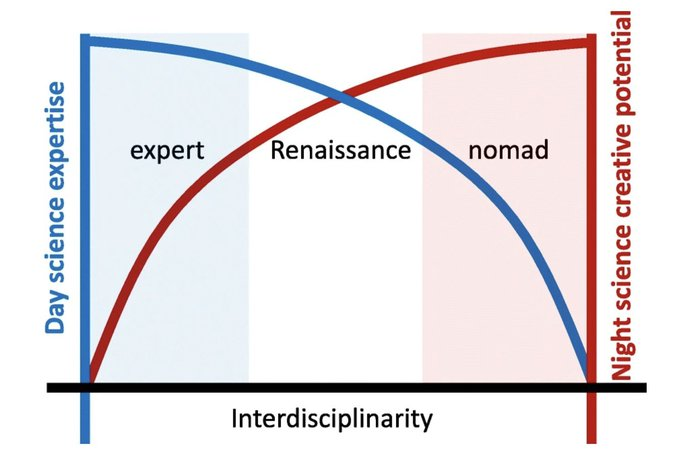
Focus Matters but Balance Matters More

Expert’s Dilemma: the more specialized you become, the less open you are to creative solutions from other fields. But the more you explore other fields, the more you risk losing credibility in your home field.

From: Renaissance minds in 21st century science Itai Yanai & Martin Lercher

Renaissance minds in 21st century science refer to researchers who cultivate interests in multiple disciplines, fostering creativity and innovation through interdisciplinary approaches[1]. This concept draws inspiration from historical figures like Leonardo da Vinci and Galileo Galilei, who excelled in various fields of study.

Day Science vs. Night Science

François Jacob distinguishes between two modes of scientific thinking:

  1. Day Science: Operates within specific scientific fields, following established protocols and paradigms[1].
  2. Night Science: A less structured process where new ideas and hypotheses are generated, often crossing disciplinary boundaries[1].

Benefits of Interdisciplinary Thinking

  1. Enhances creativity by allowing researchers to apply knowledge from one field to another[1].
  2. Enables the discovery of novel solutions to research questions in one’s primary discipline[1].
  3. Promotes lateral or horizontal thinking, leading to unexpected connections and insights[1].

The Expert’s Dilemma

While interdisciplinary thinking fosters creativity, it can also lead to a loss of credibility as a highly focused expert[1]. Scientists must balance disciplinary expertise with interdisciplinary creativity to navigate this challenge effectively.

Examples of Renaissance Minds

  1. Paul Erdös: A mathematician who frequently collaborated across various mathematical subfields[1].
  2. Albert-László Barabási: Applied network analysis concepts across multiple disciplines, leading to insights in diverse fields[1].

Renaissance minds in 21st century science embrace the idea of having an “open brain,” ready to explore new fields and make unexpected connections that drive scientific progress[1].

Citations:
[1] https://genomebiology.biomedcentral.com/articles/10.1186/s13059-020-01985-6

“smart” insulin 

Biggest medical discoveries

Researchers have developed a novel “smart” insulin called NNC2215 that shows promise in addressing one of the major challenges of insulin therapy for diabetes: the risk of hypoglycemia (dangerously low blood sugar)[1][2].

How NNC2215 Works

NNC2215 is an insulin molecule engineered with a glucose-sensitive switch consisting of two key components:

  1. A ring-shaped macrocycle structure
  2. A glucoside molecule derived from glucose

This innovative design allows NNC2215 to automatically adjust its activity based on blood glucose levels:

  • When glucose is low, the glucoside binds to the ring, keeping insulin inactive
  • As glucose rises, it displaces the glucoside, activating the insulin[3]

Key Advantages

Glucose-Responsive Action: NNC2215 can turn its activity on and off in response to changing blood sugar levels, unlike traditional insulin[3].

Hypoglycemia Prevention: In animal studies, NNC2215 demonstrated the ability to lower high blood glucose effectively while preventing the dangerous drops in blood sugar that can occur with regular insulin treatment[1][2].

Reversible Effect: Unlike some previous glucose-sensitive insulin approaches that irreversibly release insulin, NNC2215’s activity can be reined in when glucose levels fall[3].

Research Findings

Studies in pigs and diabetic rats showed that:

  • NNC2215 was as effective as human insulin in lowering blood glucose
  • It provided protection against hypoglycemia compared to a current long-acting insulin (insulin degludec)
  • During a glucose challenge, NNC2215 activation corresponded to the effect of about 30% additional human insulin[1]

In one experiment, when glucose infusion was stopped:

  • NNC2215 allowed glucose to drop to about 4.5 mM
  • Insulin degludec caused a drop to about 3 mM (hypoglycemic range)[1]

Potential Impact

This glucose-sensitive insulin could significantly improve diabetes management by:

  1. Reducing the risk of hypoglycemic events
  2. Improving quality of life for people with diabetes
  3. Potentially allowing for more aggressive glucose control with less fear of low blood sugar[2][3]

While further research is needed to optimize NNC2215 and assess its safety and efficacy in humans, this development represents a promising step toward more automated and safer insulin therapy for diabetes.

Citations:
[1] https://assets-eu.researchsquare.com/files/rs-2882397/v1/1e7e4dfd-92d3-4b6e-b79d-451074f743b0.pdf?c=1729149088
[2] https://www.nature.com/articles/s41586-024-08042-3
[3] https://www.nature.com/articles/d41586-024-03357-7
[4] https://www.news-medical.net/news/20241018/New-glucose-sensitive-insulin-NNC2215-could-transform-diabetes-care-by-lowering-hypoglycemia-risk.aspx
[5] https://pubmed.ncbi.nlm.nih.gov/39415004/?fc=None&ff=20241018054337&v=2.18.0.post9+e462414
[6] https://www.researchgate.net/publication/370676441_Glucose-sensitive_insulin_with_attenuation_of_hypoglycaemia
[7] https://twitter.com/MoEbrahimkhani/status/1846618934830944543
[8] https://twitter.com/DanielJDrucker/status/1846588322551902458